Thursday, March 25, 2021

On Tsuris: A Rock Or a Hard Place?


This summer, interested in Judaism but not quite sure where to go for information, I read Leo Rosten's The Joys of Yiddish (1968), a paperback I'd long admired in my parents' glass-fronted bookcase. There I encountered the word 'tsuris,' which means "troubles, woes, worries, suffering," according to Rosten. 'Having tsuris' is something to be avoided or bemoaned. The word 'tsuris' comes from the Hebrew 'tsarah,' (feminine), which means trouble, Rosten wrote. Perhaps the old paperback predicted the etymological predicaments I would later throw myself into, where sense and relatedness appealed but irony was what fascinated. Or not.

In any case, fast forward a few months and I was sounding out Psalm 95 on Sefaria.org.  

לְ֭כוּ נְרַנְּנָ֣ה לַיהוָ֑ה נָ֝רִ֗יעָה לְצ֣וּר יִשְׁעֵֽנוּ

"L'chu n'ran'na, Adonai, nariah l'tzur yisheinu," went the transliteration [boldface my own]. "Raise a shout . . . Adonai . . . trouble . . ." I thought. "Wait, trouble?" But no, according to the translation, it's "raise a shout for our rock and deliverer." It's just that the 'rock and deliverer' part,' 'l'tzur yisheinu' (לְצ֣וּר יִשְׁעֵֽנוּ), sounded (or looked, since I was reading) like 'tsuris.' It turns out that 'tsur' or 'tzur' (צ֣וּר) is a masculine Hebrew noun meaning 'rock or cliff,' according to Strong's Concordance. Rock means support, here. Nothing to do with trouble; nothing to see.

Some days later, though, I learned that the Hebrew word for Egypt, Mitzrayim (מִצְרַ֖יִם), can mean 'straits,' or 'narrow place' and also, figuratively, troubles. Which makes sense, given that according to the story of Exodus, the Israelites were enslaved in Egypt. I can't let go of my feeling that there has to be a connection between 'tsur' as rock on one hand and 'tsuris,' straits, and 'Mitzrayim' on the other and that this line of thinking is going to cause, well—  

It makes a kind of sense. When I imagine a strait, I see a person in a boat between two rock faces, trying or hoping not to bash into either one. I think of being 'between a rock and a hard place.' Maybe God is the rock and straits are the hard place. Or is one rock support while two are 'tsuris'?

There's an easy way to explain that God is not trouble, etymologically speaking. 'Tsarah,' the Hebrew root of 'tsuris,' is a feminine noun derived from the adjective 'tsar.' The Hebrew word for rock or cliff, on the other hand, is masculine. So they aren't the same. As for whether they could still be somehow related, that's beyond me. (Let's not even get started on the idea that trouble is female.) But what interests me are the implications of the idea that the words for 'rock,' referring to God, and 'troubles' are alike in some way, even if it only seems like that.

I thought the psalm was calling God trouble when in fact it praises God for supporting people and delivering them from their troubles (chief among them enslavement in Egypt). The mistake asks, "Could God be both trouble and the one who gets you out of it?" The question points to theodicy, or efforts to reconcile the terrible things that happen in the world with the idea that God is all powerful, all knowing, and all good. 

I like that there's a word for it, theodicy, a word that manages to encompass the problem of evil and efforts to solve it. It's much easier to dismiss religion when you think religious people just don't notice contradictions like the idea of an all-powerful God presiding over a world where horrible things happen. The fact that there's a term for the problem suggests that it has not been ignored as indeed it hasn't. As part of the process of converting to Judaism, I recently read a book (Rifat Sonsino and Daniel B. Syme, Finding God: Selected Responses, 2002 edition) that presents diverse Jewish perspectives on God from thinkers like Maimonides, Spinoza, and Mordecai Kaplan, and every single one addresses the problem of evil. These Jewish thinkers have obviously given the issue more consideration than I did, growing up in an atheist family where not believing, and not thinking about it, was the de facto solution.

I think 'tsuris' could be just another 'word for it.' It's a term that embodies a contradiction, a rock and a hard place, support and trouble, a narrows and also a way out.

From Leo Rosten's The Joys of Yiddish

Monday, March 15, 2021

Etymological Adventures: On Talent

"Free art talent test" ad
"Art Talent Test" by Howdy, I'm H. Michael Karshis is licensed under CC BY 2.0

Talent is, arguably, a valuable thing. I say arguably because I feel that talent often stands in opposition to skill. People tend to be called 'talented' when they show promise but are not yet accomplished. I remember as a beginning violin student talent being measured in terms of Suzuki books per year, age versus skill, or how long you'd been taking private lessons relative to how well you played. Things that in hindsight are not important. "Do you like playing?" is more important. Talent is valuable, but it's not everything. It can also go to waste; it can go undeveloped. It doesn't necessarily do a person or the world any good, but it represents the potential for future skill and creativity. That potential certainly is valuable. 

So I was delighted but not surprised to learn in last week's Torah portion that talent actually is a measure of value: It's a particular weight of gold (or silver or copper). The Israelites, who have left Egypt and received the commandments, are constructing a sanctuary. For this purpose, a man named Bezalel makes a lamp stand "out of a talent of pure gold" (Exodus 37:24). Talent, here, seems to be a unit of measure. Highlight the Hebrew word on Sefaria and it will tell you that it means "a round weight, talent (of gold, silver, bronze, iron)." Yet it could be a double entendre. God has, according to Moses, "endowed [Bezalel] with a divine spirit of skill, ability, and knowledge in every kind of craft" (Exodus 35:31). The man had talent, and it went into the menorah along with the gold. 

According to Chambers Etymological Dictionary, the literal meaning of talent as money came first. Talent as "special natural ability, aptitude" arose in the 15th century, a figurative use of the original term "taken from the parable of the talents in the Bible (Matthew 25:14-30)," according to Chambers. No mention of Bezalel, alas. 

In the story, a 'lord' gives out several bags of gold to three of his servants. Two of the servants take their literal talents, invest them, and wind up twice as rich as they began. But the servant who receives only one bag of gold digs a hole and buries it, earning nothing but disapproval from the lord, who had hoped to profit from his servants' investments. I suppose the story shows that you should develop your talent. On the other hand, the lord disbursing gold in this story doesn't seem like such a great guy. He's described as someone who harvests where he hasn't sown. Maybe I, too, would want to bury his money.  

The lord gave the third servant a talent of gold. I'm not sure how much that's worth, but a talent of silver is equivalent to three thousand shekels, according to the website Learn Religions. In biblical times, a shekel was a day's wage. The same website says that a talent was something like 20 years' earnings for a laborer. This doesn't quite compute (3,000 shekels per talent/365 shekels per year=about 8 years per talent), but suffice it to say that talent is precious and not easily earned.

I don't actually think it's possible to earn talent. A musician of moderate ability who works all her life may never play as well as an eight-year-old prodigy, for example. And even if, technically, a person reaches a certain level, will they have 'it,' the je ne sais quois? I'm skeptical.  

I do, however, believe that talent demands work and that work picks up where talent leaves off. If you truly bury your talent, that is, don't even pursue the area in which you are gifted, you can't possibly succeed in that area. Not only that but you may miss out on experiences that would be valuable to you, regardless of how others might judge them. On the other hand, someone with less talent and a lot of dedication may fare quite well. 

What does it mean to "fare well" or "succeed"? These matters are subjective, and what matters most is probably personal satisfaction. Hopefully the person who buries their talent doesn't simultaneously use it to measure their self-worth (though I think if it can be done, people do it). 

I had some talent as a violinist, but I put it down in college and focused on something else. I still play the fiddle sometimes, less on my own and more when it's a way to get together with a group of people. My ability to learn tunes by ear serves me well. I also go for long periods without playing. 

A biblical talent weighed something like 75 pounds. I can understand someone wanting to put it down. The feeling that you have all this potential (and I think it's easy to overestimate your own talent) and that turning out to be anything less than extraordinary will be a disappointment is emotionally heavy. Yet when I pick up the violin now, I'm not re-shouldering a burden, or I try not to make it about that. It's about enjoying music.

Skill comes from both talent and experience, yet I don't want to seek an exchange rate between the two. It certainly does take time and work, maybe even a Gladwellian 10,000 hours, maybe even 8 or 20 years, to really develop a skill, no matter how talented you are. A more talented person might achieve a given level slightly faster, or not. But at a certain point, when the answer to "how long have you played the violin?" is 30 years and it no longer relates to how well you play but to the length of your life, it no longer matters exactly how fast you progressed through the Suzuki books in elementary school. As for Bezalel's menorah, what matters is not how quickly he made it, how many years he'd studied as a goldsmith before making it, how old he was when God chose him to make it, whether or not other more experienced goldsmiths were passed over for the job, none of which the Torah tells us, but the fact that he made it and that it served a purpose. As they say, talent's overrated.

Thursday, March 4, 2021

Etymological Adventures: On Lots and Happenstance

2 Purim baskets
Yoninah, CC BY-SA 3.0, via Wikimedia Commons

"Happy Purim!" Jews and non-Jew celebrants, like myself, greeted each other last week. We might as well have been saying "happy lots," "happy fate," or "lucky fate." A religious holiday run through with the language of chance, Purim, the Festival of Lots, made me consider how we think about luck in our lives. Is chance unfeeling math at work? Or a manifestation of the divine? What is the source of a 'happy lot'? Wherever it comes from, chance, as a concept, is ubiquitous.

In biblical times, people engaged with chance and probability by 'casting lots.' The practice may have involved drawing stones—like straws—to decide who would do something or throwing down stones and interpreting how they fell to reach a conclusion. Casting lots is similar to gambling, hence the related word, lottery. In the Purim story, the evil Haman cast lots, called purim in Hebrew, to decide on which day to kill all the Jews in Shushan. On that very date, as it turned out in the story, the Jews prevailed, making Purim a happy holiday.  

Happy comes from the English 'hap,' which means "chance, fortune, luck." The verb happen has the same root.

Purim, the Hebrew word for lots, can also mean 'portions.' It so happens that 'sending portions,' or 'mishloach manot,' is a Purim tradition; people give each other baskets of hamantaschen and other delectables. 'Manot' (singular: mana) means portions. Unlike purim, though, manot does not also means lots.

Casting lots is a matter of probability and statistics, random chance. How distant that feels from the idea, which I think of as being at the heart of religion, that things happen for a reason. 

I do think of chance as controlling what happens, to an extent. Yet things do not happen quite as statistics predict. Random number generators produce strings of repeats; flipped coins repeatedly land on their heads. In the long run, the textbooks say, reality operates closer to statistical prediction, but no run is infinite. In what happens—and whom it happens to—there's always an element of luck. 

Statistics tell you what the distribution is: that there is a bell curve and that average values occur more often than extremes. But what controls an individual's position on the curve? Who is the distributor? In this human drama, who is in charge of casting?

Some people believe the answer is God. In the Bible, people cast lots not as a way of letting chance decide but in order to determine God's will. (That said, God is not mentioned in the Purim story; it's said that God is masked within it.) 

For me, the idea that statistics could be God-given raises the question of whether God is actually up there flipping coins. In Judaism, there's much talk of God 'dealing fairly' with people. One interpretation of that phrase is that God is giving every individual attention and consideration. But another take on it is that God is the dealer in the sky, distributing fates with a certain cold objectivity. The latter doesn’t strike me as a metaphor of fairness. Or is it the ultimate fairness, as long as God shuffles the cards?

'Bonne chance' means good luck in French. The phrase appeals to me because it expresses the idea that luck and chance are the same thing and not unqualifiedly good. Yes, lucky refers to good luck and Fortune smiles—but sometimes she frowns. 'By chance' in French is 'par hasard.' Chance, with a hint of peril.

When I write, I sometimes feel as if I'm throwing words at the page in hopes that they will land in meaningful arrangements. I think about words and their origins and hope to make sense of them. Often I can, but not always. I originally thought mana, the singular word for portion in the phrase mishloach manot, might also refer to the food that God provided the Israelites during their desert wanderings. God apportioned food, made allotments. Yet although a Purim basket might feel like a kind of manna, "a usually sudden or unexpected source of pleasure, gratification, or gain" or "food miraculously supplied," as Merriam-Webster defines it, the manna of the desert and the mana of Purim and mishloach manot are not etymologically related, as far as I can tell. The Hebrew words are different genders. Nice try, I think to myself. Better luck next time.

What is luckier, though, really—for words with common origins to sound alike and have similar meanings? Or for etymological strangers to connect? The former is about as "lucky" as learning that you resemble your great-grandmother. The latter, though—for words without a common root to not only sound alike but also relate meaningfully to each other—that's really something. I wouldn't go so far as to call it "divinely supplied spiritual nourishment." Or maybe I would. 

Tuesday, February 23, 2021

Etymological Adventures: On Scrolls and Scrolling

Torah scroll with yad (pointer)

When you scroll on your phone, what do you imagine happens to the text—or Tweets or photos—you can’t see? I imagine the material on the screen continuing straight up, forever. But the verb ‘to scroll’ suggests something else—that our Instagram and Facebook feeds are rolling up behind the tops of our phone screens once they slip out of sight and are at the same time unrolling before our eyes from an invisible reel at the bottom. It’s as if behind-the-scenes work, akin to the little people who live inside the television, is unfolding at the edges of our phones. 

Scroll is my word for the week. It’s on my mind because the Jewish holiday of Purim is this Thursday, and it's a Purim tradition for the Scroll of Esther—a.k.a. Megillat Esther a.k.a. ‘the megillah’—to be read aloud in synagogues. The Scroll of Esther, or Book of Esther, is one of the Kethuvim (Writings) and is within the non-Torah part of the Jewish Bible. It tells the story of how Jews in Persia escaped extermination by Haman, the king’s angry advisor (and namesake of hamantaschen cookies), thanks to the titular Queen Esther. 

I am a non-Jew learning about Judaism, and this will be my first time celebrating Purim. There are lots of things I don’t know about the holiday, such as whether the megillah is actually a separate physical scroll or whether it’s connected to other writings the way the five books of the Torah are all written on one scroll. I also don’t know how long it takes to read ‘the whole megillah’ (Purim is where that expression comes from). But what I have learned and can report here is that the word megillah means scroll in Hebrew. 

The Hebrew root of megillah means ‘to roll,’ according to Wiktionary, which in turn cites the biblical lexicon Strong’s Concordance. This seems quite appropriate for a scroll, a document through which you move by rolling up the part you’ve just read and unrolling what’s to come. So it is for the English word scroll, which has ‘roll’ contained within it. The origins of the English word—from Old French escroe, “scrap, roll of parchment,” according to the Online Etymological Dictionary—are not particularly enlightening, except for this one tidbit: “Sense of ‘show a few lines at a time" (on a computer or TV screen) first recorded 1981.’” 1981!—the year the first IBM personal computer came out, according to this Live Science article, but decades before the iPhone. 

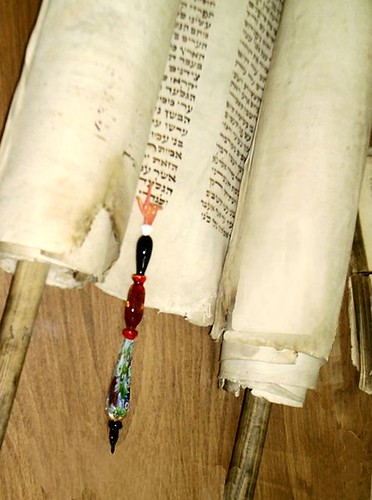
Before I ever attended a Torah service, which is something I’ve only ever done online, I imagined a scroll as something a courtly figure would unroll vertically, like a roll of toilet paper, and that if the document were too long, the end would drag on the ground. I was surprised, then, to learn that a Torah scroll has two rollers, one at each end, and that what you’re reading is between them. You don’t read down a Torah scroll the way I’d imagined a courtier reading a scroll from top to bottom (or the way you read your phone). To be more precise, you don’t read the Torah scroll in the direction of its scrolling. Instead, you read in columns across it, columns perpendicular to the way it rolls and unrolls. 

A Torah scroll with its two rollers and a yad
"Torah" by Lawrie Cate is licensed under CC BY 2.0

Like on a phone, though, the viewing area of a Torah scroll is always roughly the same size, limited, I guess, by the size of the bimah, the platform from which it is read in the synagogue. Another similarity between reading a Torah scroll and scrolling on a phone is the role of the finger. On the phone, you flick the feed along with your index finger. You keep your place on a Torah scroll with a miniature hand on a stick, called a yad, which has its own miniature pointer finger extended. 

Screenshot of a phone viewing the Book of Esther on Sefaria.org

Of course you can read the Torah, or the Book of Esther, on your phone. In that case, then, the verb ‘scroll’ is particularly appropriate. 

A violin
"Violin" by pellaea is licensed under CC BY 2.0

It occurred to me as I searched for photos to accompany this blog post that not all scrolls have anything to do with reading, or even looking at photos. I may be learning about Judaism, but perhaps I'm forgetting about the violin, something to which I am not new at all and something that, as the Creative Commons image search tool reminded me when I typed in 'scroll', also has one. You can't roll or unroll it. It's carved in the wood. It's within the scroll, however, that the instrument's strings are wound and unwound in the process of tuning. A balance is reached between the strings; they have concordances between them. Tuning is something delicate and important, a sacred scrolling.

Sunday, February 14, 2021

Etymological Adventures: Doff and don

This week, I was writing an article about a shoe designed to be easy to put on and take off. Ah, the frustration of writing that phrase, to put on and take off. I wanted to shorten it: put on and off, take on and off. But you don't 'put off' or 'take on' your shoes unless you're in some sort of argument or fight, with your footwear. What I really wanted to write was that this shoe is 'easy to doff and don.' But some readers might not understand me if I wrote that, and I wasn't willing to sacrifice clarity for brevity (if making the piece two words shorter can be considered real progress toward brevity). So let's go on and on about doff and don in a separate article! 

Doff and don do indeed mean to take off and to put on, respectively. They are contractions of 'do off' and 'do on,' according to Chambers Etymological Dictionary. 'Do' once had the meaning 'to put or place,' it seems. The Shorter O lists 'put or place' as the first meaning of 'do.' It then goes on to say that this meaning is "obs. exc. dial., with preps. (see do off etc. below)." I think the Shorter O would do well to pay a bit more attention to clarity, here. Expanding the abbreviations, the Shorter O is saying that the put or place meaning of do is obsolete except for dialect-related uses with prepositions. Prepositions such as off and on! 

Memorizing the prepositions was something many students of my generation did at some point. I did that exercise in the 8th grade. A preposition, we learned, is something a squirrel could do to a tree. Well, not exactly. The squirrel goes _____ the tree, the blank being the preposition. The squirrel goes around the tree. The squirrel goes up the tree. The squirrel [tries to go] through the tree. As I contemplated writing this post, I of course wondered what other 'do + preposition' constructions might be out there waiting to be discovered. For ease of contraction, the prepositions would need to start with vowels. There aren't many exciting options. Maybe we could start using 'dup' as a contraction of 'do up,' as in 'I dupped my hair because it was hot.' Or 'dover' could mean 'do over.' 

It turns out that 'dup' is already a word, albeit an archaic one. This contraction of 'do up' means to open, according to the Shorter O. Let's see that squirrel try to dup the tree. Dover is also a word. According to the Shorter O, to dover means to "doze or be unconscious" or to cause to doze or be unconscious. Or to "wander aimlessly or confusedly; walk unsteadily." Dover can also mean, as a noun, "a light or fitful sleep; a doze," according to the Shorter O. Dover's powder, the next entry in the Shorter O, is "a mixture of opium and ipecacuanha." You might think it would be used to dover people, that is, put them to sleep, especially given the opium content, but no. It was named after physician Thomas Dover. According to the definition in the Shorter O, Dover's powder was used to ease pain. Or induce sweating. I don't think the tree will be in need of dovering from the squirrel. For now, I will give the squirrel a break and sign off.  

Sunday, February 7, 2021

Etymological Adventures: Biblio- and Beyond

Bibliophile. Bibliography. Of all word roots, I'd say that biblio-, meaning book, is one of the most basic, for me, anyway. I feel like I've known what it meant for a long time. Why, then, did it take 36 years for me to notice that the word Bible might potentially have the very same root? That's not an interesting question, but the connection between Bible and biblio, on the other hand, is very cool.

Yes, these words all have the same root. Merriam-Webster gives me a game-of-telephone-like history of the word bible (Middle English from Old French from Medieval Latin from Greek) that goes all the way back to the Greek byblos, meaning papyrus, or book. Byblos, in turn, was the name of an ancient city that exported papyrus. 

When the connection between Bible and biblio hit me, it reminded me of something I read in The Broken Estate: Essays on Literature and Belief, by literary critic James Wood. Wood describes the belief, indeed still held by many people, that the Bible was a God-given account of the history of the world, the absolute truth. He calls this idea the old estate, and in his book, particularly in the introductory essay "The Freedom of Not Quite" and in the title essay, Wood describes how novels broke the old estate, or cracked it, anyway. When the Bible was considered truth, it perhaps didn't occur to people that books could be anything other than true. Novels, Wood says--and particularly novels about religious figures--changed that. All of a sudden there were these books that felt as true or truer than the Bible, yet they were entirely made up by ordinary people. Was the Bible made up, too? The existence of novels made people wonder. 

It's as if, it seems to me, book originally meant the word of God as recorded by prophets. Maybe, at one time, book was a sufficient description for a religion's foundational, even holy, text. Once regular people started writing books that were patently fictional, it became necessary to find words to distinguish The Book from others. At the same time, as Wood points out in "The Freedom of Not Quite," many people also had and still have reverence for fiction, further complicating the task of distinguishing what's holy and what's not. "At the high point of the novel's rise, the Gospels began to be read, by both writers and theologians, as a set of fictional tales--as a kind of novel. Simultaneously, fiction became an almost religious activity (though not of course with religion's former truth-value, for this was no longer quite believed in)," Wood writes. 

Other books do have other names: novel, memoir, stories, essays. Nonfiction is defined relative to fiction, almost as if fiction is the default. We don't have, for example, books categorized as truth and untruth. Yet the Bible, if you think about its derivation, is still basically called The Book. 

PS: Chambers Etymological Dictionary says that in addition to book, the root biblio- can refer to the Bible, "as in bibliolatry = excessive reverence for the Bible." So there you go.

Sunday, January 31, 2021

Etymological Adventures: Amen

Amen. It’s a sign of agreement. It’s the end of a prayer. It’s a word I never thought to wonder what it meant in some other language because its meaning in English is so clear. But yesterday it occurred to me to wonder, and what I found was meaningful in more ways than one. In Hebrew, I learned, amen (אָמַן) is a verb that means to be faithful, stand firm, or to believe. 

As I am currently learning about Judaism, I discovered this reading the weekly Torah portion, Beshalach, in which God parts the waters of the Red Sea and the Israelites cross over into the Promised Land. I was reading in English, but a particular phrase caught my attention and I wondered what it was in Hebrew. In English, the phrase was “[. . . the people] believed in the Lord and in Moses” (from Exodus 14:31), as translated on Chabad.org. Since believing in God is, in any Bible, an important idea, I wondered how to say ‘believe in God’ in Biblical Hebrew. What I saw was that the Hebrew word for believe looked to my eyes—which know the Hebrew alphabet but no grammar—a whole lot like amen. 

Over at Sefaria.org, an amazing hyperlinked repository of Jewish texts, the phrase was translated “they had faith in the Lord and His servant Moses.” Yet when I clicked on the key Hebrew word and the definition popped up on the right of the screen, there it was: amen, a verb meaning, among other things, to trust or believe. 

So amen is an expression of faith or belief. It’s not so surprising, now that I know. Yet I didn’t know. I didn’t really think it meant anything. I thought it was a word whose meaning was self-evident, like ‘ouch!’ 

On that note, what part of speech is it, anyway, at the end of a prayer? It doesn’t seem like a verb as used in that context. It’s just something people say, as in “and we say: Amen.” Merriam-Webster says amen is an interjection (like ‘ouch,’ I might add). Find amen in a prayer on Sefaria, and the Klein Dictionary will tell you that it can mean “so be it, truly, certainly,” which make it sound, ‘so be it’ aside, like an adverb. Sort of like ‘indeed.’ 

When amen means ‘so be it,’ it doesn’t necessarily signify agreement. It can be an expression of resignation. In the story of the two angels who accompany someone home from a Friday night shabbat service, one angel who wants the house to be neat and tidy and ready for 25 restful hours, the other who wants it to be messy, one of the angels has to concede to the other when their person arrives home to the house, in whatever state it may be in, and the angel does that by saying ‘amen.’ 

One of my favorite things about learning new words is that they tend to pop up everywhere, and so it was with amen once I discovered its various Hebrew meanings. I found it in a psalm sung on shabbat, and the interesting thing about that was that in that case, God was the one being described as being faithful, to people. The word amen can refer to people believing in or being faithful to God, but it can also indicate the other half of an apparently reciprocal relationship. I find that satisfying.