Thursday, March 4, 2021

Etymological Adventures: On Lots and Happenstance

2 Purim baskets
Yoninah, CC BY-SA 3.0, via Wikimedia Commons

"Happy Purim!" Jews and non-Jew celebrants, like myself, greeted each other last week. We might as well have been saying "happy lots," "happy fate," or "lucky fate." A religious holiday run through with the language of chance, Purim, the Festival of Lots, made me consider how we think about luck in our lives. Is chance unfeeling math at work? Or a manifestation of the divine? What is the source of a 'happy lot'? Wherever it comes from, chance, as a concept, is ubiquitous.

In biblical times, people engaged with chance and probability by 'casting lots.' The practice may have involved drawing stones—like straws—to decide who would do something or throwing down stones and interpreting how they fell to reach a conclusion. Casting lots is similar to gambling, hence the related word, lottery. In the Purim story, the evil Haman cast lots, called purim in Hebrew, to decide on which day to kill all the Jews in Shushan. On that very date, as it turned out in the story, the Jews prevailed, making Purim a happy holiday.  

Happy comes from the English 'hap,' which means "chance, fortune, luck." The verb happen has the same root.

Purim, the Hebrew word for lots, can also mean 'portions.' It so happens that 'sending portions,' or 'mishloach manot,' is a Purim tradition; people give each other baskets of hamantaschen and other delectables. 'Manot' (singular: mana) means portions. Unlike purim, though, manot does not also means lots.

Casting lots is a matter of probability and statistics, random chance. How distant that feels from the idea, which I think of as being at the heart of religion, that things happen for a reason. 

I do think of chance as controlling what happens, to an extent. Yet things do not happen quite as statistics predict. Random number generators produce strings of repeats; flipped coins repeatedly land on their heads. In the long run, the textbooks say, reality operates closer to statistical prediction, but no run is infinite. In what happens—and whom it happens to—there's always an element of luck. 

Statistics tell you what the distribution is: that there is a bell curve and that average values occur more often than extremes. But what controls an individual's position on the curve? Who is the distributor? In this human drama, who is in charge of casting?

Some people believe the answer is God. In the Bible, people cast lots not as a way of letting chance decide but in order to determine God's will. (That said, God is not mentioned in the Purim story; it's said that God is masked within it.) 

For me, the idea that statistics could be God-given raises the question of whether God is actually up there flipping coins. In Judaism, there's much talk of God 'dealing fairly' with people. One interpretation of that phrase is that God is giving every individual attention and consideration. But another take on it is that God is the dealer in the sky, distributing fates with a certain cold objectivity. The latter doesn’t strike me as a metaphor of fairness. Or is it the ultimate fairness, as long as God shuffles the cards?

'Bonne chance' means good luck in French. The phrase appeals to me because it expresses the idea that luck and chance are the same thing and not unqualifiedly good. Yes, lucky refers to good luck and Fortune smiles—but sometimes she frowns. 'By chance' in French is 'par hasard.' Chance, with a hint of peril.

When I write, I sometimes feel as if I'm throwing words at the page in hopes that they will land in meaningful arrangements. I think about words and their origins and hope to make sense of them. Often I can, but not always. I originally thought mana, the singular word for portion in the phrase mishloach manot, might also refer to the food that God provided the Israelites during their desert wanderings. God apportioned food, made allotments. Yet although a Purim basket might feel like a kind of manna, "a usually sudden or unexpected source of pleasure, gratification, or gain" or "food miraculously supplied," as Merriam-Webster defines it, the manna of the desert and the mana of Purim and mishloach manot are not etymologically related, as far as I can tell. The Hebrew words are different genders. Nice try, I think to myself. Better luck next time.

What is luckier, though, really—for words with common origins to sound alike and have similar meanings? Or for etymological strangers to connect? The former is about as "lucky" as learning that you resemble your great-grandmother. The latter, though—for words without a common root to not only sound alike but also relate meaningfully to each other—that's really something. I wouldn't go so far as to call it "divinely supplied spiritual nourishment." Or maybe I would. 

Tuesday, February 23, 2021

Etymological Adventures: On Scrolls and Scrolling

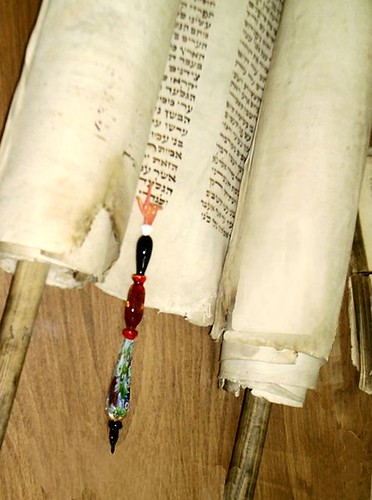
Torah scroll with yad (pointer)

When you scroll on your phone, what do you imagine happens to the text—or Tweets or photos—you can’t see? I imagine the material on the screen continuing straight up, forever. But the verb ‘to scroll’ suggests something else—that our Instagram and Facebook feeds are rolling up behind the tops of our phone screens once they slip out of sight and are at the same time unrolling before our eyes from an invisible reel at the bottom. It’s as if behind-the-scenes work, akin to the little people who live inside the television, is unfolding at the edges of our phones. 

Scroll is my word for the week. It’s on my mind because the Jewish holiday of Purim is this Thursday, and it's a Purim tradition for the Scroll of Esther—a.k.a. Megillat Esther a.k.a. ‘the megillah’—to be read aloud in synagogues. The Scroll of Esther, or Book of Esther, is one of the Kethuvim (Writings) and is within the non-Torah part of the Jewish Bible. It tells the story of how Jews in Persia escaped extermination by Haman, the king’s angry advisor (and namesake of hamantaschen cookies), thanks to the titular Queen Esther. 

I am a non-Jew learning about Judaism, and this will be my first time celebrating Purim. There are lots of things I don’t know about the holiday, such as whether the megillah is actually a separate physical scroll or whether it’s connected to other writings the way the five books of the Torah are all written on one scroll. I also don’t know how long it takes to read ‘the whole megillah’ (Purim is where that expression comes from). But what I have learned and can report here is that the word megillah means scroll in Hebrew. 

The Hebrew root of megillah means ‘to roll,’ according to Wiktionary, which in turn cites the biblical lexicon Strong’s Concordance. This seems quite appropriate for a scroll, a document through which you move by rolling up the part you’ve just read and unrolling what’s to come. So it is for the English word scroll, which has ‘roll’ contained within it. The origins of the English word—from Old French escroe, “scrap, roll of parchment,” according to the Online Etymological Dictionary—are not particularly enlightening, except for this one tidbit: “Sense of ‘show a few lines at a time" (on a computer or TV screen) first recorded 1981.’” 1981!—the year the first IBM personal computer came out, according to this Live Science article, but decades before the iPhone. 

Before I ever attended a Torah service, which is something I’ve only ever done online, I imagined a scroll as something a courtly figure would unroll vertically, like a roll of toilet paper, and that if the document were too long, the end would drag on the ground. I was surprised, then, to learn that a Torah scroll has two rollers, one at each end, and that what you’re reading is between them. You don’t read down a Torah scroll the way I’d imagined a courtier reading a scroll from top to bottom (or the way you read your phone). To be more precise, you don’t read the Torah scroll in the direction of its scrolling. Instead, you read in columns across it, columns perpendicular to the way it rolls and unrolls. 

A Torah scroll with its two rollers and a yad
"Torah" by Lawrie Cate is licensed under CC BY 2.0

Like on a phone, though, the viewing area of a Torah scroll is always roughly the same size, limited, I guess, by the size of the bimah, the platform from which it is read in the synagogue. Another similarity between reading a Torah scroll and scrolling on a phone is the role of the finger. On the phone, you flick the feed along with your index finger. You keep your place on a Torah scroll with a miniature hand on a stick, called a yad, which has its own miniature pointer finger extended. 

Screenshot of a phone viewing the Book of Esther on Sefaria.org

Of course you can read the Torah, or the Book of Esther, on your phone. In that case, then, the verb ‘scroll’ is particularly appropriate. 

A violin
"Violin" by pellaea is licensed under CC BY 2.0

It occurred to me as I searched for photos to accompany this blog post that not all scrolls have anything to do with reading, or even looking at photos. I may be learning about Judaism, but perhaps I'm forgetting about the violin, something to which I am not new at all and something that, as the Creative Commons image search tool reminded me when I typed in 'scroll', also has one. You can't roll or unroll it. It's carved in the wood. It's within the scroll, however, that the instrument's strings are wound and unwound in the process of tuning. A balance is reached between the strings; they have concordances between them. Tuning is something delicate and important, a sacred scrolling.

Sunday, February 14, 2021

Etymological Adventures: Doff and don

This week, I was writing an article about a shoe designed to be easy to put on and take off. Ah, the frustration of writing that phrase, to put on and take off. I wanted to shorten it: put on and off, take on and off. But you don't 'put off' or 'take on' your shoes unless you're in some sort of argument or fight, with your footwear. What I really wanted to write was that this shoe is 'easy to doff and don.' But some readers might not understand me if I wrote that, and I wasn't willing to sacrifice clarity for brevity (if making the piece two words shorter can be considered real progress toward brevity). So let's go on and on about doff and don in a separate article! 

Doff and don do indeed mean to take off and to put on, respectively. They are contractions of 'do off' and 'do on,' according to Chambers Etymological Dictionary. 'Do' once had the meaning 'to put or place,' it seems. The Shorter O lists 'put or place' as the first meaning of 'do.' It then goes on to say that this meaning is "obs. exc. dial., with preps. (see do off etc. below)." I think the Shorter O would do well to pay a bit more attention to clarity, here. Expanding the abbreviations, the Shorter O is saying that the put or place meaning of do is obsolete except for dialect-related uses with prepositions. Prepositions such as off and on! 

Memorizing the prepositions was something many students of my generation did at some point. I did that exercise in the 8th grade. A preposition, we learned, is something a squirrel could do to a tree. Well, not exactly. The squirrel goes _____ the tree, the blank being the preposition. The squirrel goes around the tree. The squirrel goes up the tree. The squirrel [tries to go] through the tree. As I contemplated writing this post, I of course wondered what other 'do + preposition' constructions might be out there waiting to be discovered. For ease of contraction, the prepositions would need to start with vowels. There aren't many exciting options. Maybe we could start using 'dup' as a contraction of 'do up,' as in 'I dupped my hair because it was hot.' Or 'dover' could mean 'do over.' 

It turns out that 'dup' is already a word, albeit an archaic one. This contraction of 'do up' means to open, according to the Shorter O. Let's see that squirrel try to dup the tree. Dover is also a word. According to the Shorter O, to dover means to "doze or be unconscious" or to cause to doze or be unconscious. Or to "wander aimlessly or confusedly; walk unsteadily." Dover can also mean, as a noun, "a light or fitful sleep; a doze," according to the Shorter O. Dover's powder, the next entry in the Shorter O, is "a mixture of opium and ipecacuanha." You might think it would be used to dover people, that is, put them to sleep, especially given the opium content, but no. It was named after physician Thomas Dover. According to the definition in the Shorter O, Dover's powder was used to ease pain. Or induce sweating. I don't think the tree will be in need of dovering from the squirrel. For now, I will give the squirrel a break and sign off.  

Sunday, February 7, 2021

Etymological Adventures: Biblio- and Beyond

Bibliophile. Bibliography. Of all word roots, I'd say that biblio-, meaning book, is one of the most basic, for me, anyway. I feel like I've known what it meant for a long time. Why, then, did it take 36 years for me to notice that the word Bible might potentially have the very same root? That's not an interesting question, but the connection between Bible and biblio, on the other hand, is very cool.

Yes, these words all have the same root. Merriam-Webster gives me a game-of-telephone-like history of the word bible (Middle English from Old French from Medieval Latin from Greek) that goes all the way back to the Greek byblos, meaning papyrus, or book. Byblos, in turn, was the name of an ancient city that exported papyrus. 

When the connection between Bible and biblio hit me, it reminded me of something I read in The Broken Estate: Essays on Literature and Belief, by literary critic James Wood. Wood describes the belief, indeed still held by many people, that the Bible was a God-given account of the history of the world, the absolute truth. He calls this idea the old estate, and in his book, particularly in the introductory essay "The Freedom of Not Quite" and in the title essay, Wood describes how novels broke the old estate, or cracked it, anyway. When the Bible was considered truth, it perhaps didn't occur to people that books could be anything other than true. Novels, Wood says--and particularly novels about religious figures--changed that. All of a sudden there were these books that felt as true or truer than the Bible, yet they were entirely made up by ordinary people. Was the Bible made up, too? The existence of novels made people wonder. 

It's as if, it seems to me, book originally meant the word of God as recorded by prophets. Maybe, at one time, book was a sufficient description for a religion's foundational, even holy, text. Once regular people started writing books that were patently fictional, it became necessary to find words to distinguish The Book from others. At the same time, as Wood points out in "The Freedom of Not Quite," many people also had and still have reverence for fiction, further complicating the task of distinguishing what's holy and what's not. "At the high point of the novel's rise, the Gospels began to be read, by both writers and theologians, as a set of fictional tales--as a kind of novel. Simultaneously, fiction became an almost religious activity (though not of course with religion's former truth-value, for this was no longer quite believed in)," Wood writes. 

Other books do have other names: novel, memoir, stories, essays. Nonfiction is defined relative to fiction, almost as if fiction is the default. We don't have, for example, books categorized as truth and untruth. Yet the Bible, if you think about its derivation, is still basically called The Book. 

PS: Chambers Etymological Dictionary says that in addition to book, the root biblio- can refer to the Bible, "as in bibliolatry = excessive reverence for the Bible." So there you go.

Sunday, January 31, 2021

Etymological Adventures: Amen

Amen. It’s a sign of agreement. It’s the end of a prayer. It’s a word I never thought to wonder what it meant in some other language because its meaning in English is so clear. But yesterday it occurred to me to wonder, and what I found was meaningful in more ways than one. In Hebrew, I learned, amen (אָמַן) is a verb that means to be faithful, stand firm, or to believe. 

As I am currently learning about Judaism, I discovered this reading the weekly Torah portion, Beshalach, in which God parts the waters of the Red Sea and the Israelites cross over into the Promised Land. I was reading in English, but a particular phrase caught my attention and I wondered what it was in Hebrew. In English, the phrase was “[. . . the people] believed in the Lord and in Moses” (from Exodus 14:31), as translated on Chabad.org. Since believing in God is, in any Bible, an important idea, I wondered how to say ‘believe in God’ in Biblical Hebrew. What I saw was that the Hebrew word for believe looked to my eyes—which know the Hebrew alphabet but no grammar—a whole lot like amen. 

Over at Sefaria.org, an amazing hyperlinked repository of Jewish texts, the phrase was translated “they had faith in the Lord and His servant Moses.” Yet when I clicked on the key Hebrew word and the definition popped up on the right of the screen, there it was: amen, a verb meaning, among other things, to trust or believe. 

So amen is an expression of faith or belief. It’s not so surprising, now that I know. Yet I didn’t know. I didn’t really think it meant anything. I thought it was a word whose meaning was self-evident, like ‘ouch!’ 

On that note, what part of speech is it, anyway, at the end of a prayer? It doesn’t seem like a verb as used in that context. It’s just something people say, as in “and we say: Amen.” Merriam-Webster says amen is an interjection (like ‘ouch,’ I might add). Find amen in a prayer on Sefaria, and the Klein Dictionary will tell you that it can mean “so be it, truly, certainly,” which make it sound, ‘so be it’ aside, like an adverb. Sort of like ‘indeed.’ 

When amen means ‘so be it,’ it doesn’t necessarily signify agreement. It can be an expression of resignation. In the story of the two angels who accompany someone home from a Friday night shabbat service, one angel who wants the house to be neat and tidy and ready for 25 restful hours, the other who wants it to be messy, one of the angels has to concede to the other when their person arrives home to the house, in whatever state it may be in, and the angel does that by saying ‘amen.’ 

One of my favorite things about learning new words is that they tend to pop up everywhere, and so it was with amen once I discovered its various Hebrew meanings. I found it in a psalm sung on shabbat, and the interesting thing about that was that in that case, God was the one being described as being faithful, to people. The word amen can refer to people believing in or being faithful to God, but it can also indicate the other half of an apparently reciprocal relationship. I find that satisfying.

Tuesday, April 30, 2019

Given the Chance, Might Emerence Have Forgiven Magda in THE DOOR?


Magda Szabó’s novel The Door opens and closes with a dream. Last night, I dreamed about The Door, sort of. I dreamed that I was in the kitchen with another woman at work cooking, and even though I knew I wasn’t expected to help, I also felt that to not help would be a weakness, a character flaw, and an absence of action that I’d regret. So there I was, chopping an onion or radish or something with this other woman nearby, half feeling pleased about helping, half worrying the woman would scold me for the way I was doing it. She didn’t. Then I was putting something in the freezer and noticed ice-cube trays but also thought to myself that I shouldn’t snoop in the woman’s freezer. The refrigerator, after all, was off limits altogether. I regarded its beige front. Nobody but Emerence opened the door of that fridge. Only she knew what was inside.

In The Door (New York Review Books, 2015, translated from Hungarian by Len Rix), the caretaker Emerence opens the door of her flat to almost no one. Only the novel’s narrator, a writer named Magda, sees inside while Emerence is alive. Emerence works for Magda, taking care of her apartment while Magda writes, and they become close. Emerence comes to trust Magda enough to decide to leave the contents of her flat to Magda after she dies. Unfortunately for everyone,

SPOILER ALERT SPOILER ALERT SPOILER ALERT SPOILER ALERT

before that, Magda manages to betray Emerence by tricking her into opening her door at a critical moment, a decision with devastating consequences.

As evidenced by my dream, I think about Emerence a lot. I imagine how I would treat Emerence if she were in my life—what mistakes I would make, how I might avoid them. I failed to give up my seat to an Emerence on the train the other day, with The Door in hand, no less. Hopefully next time, I’ll do better.

Since Emerence in my life is not an individual but every encounter that forces a quick decision about how to treat people, I do, unlike Magda, have second chances. Yet I wonder, is it possible that Emerence might have forgiven Magda—given her a second chance—if Magda had done just one thing differently? I’d like to think so, of course.
*
I don’t normally think about “what might have been” had a character in a book acted differently. Asking that question isn’t going to deepen understanding of the book; it’s an idea for a different book. And I think it’s important to stay close to the text when exploring what books are trying to say. If you can’t back an assertion up with a quote, maybe you shouldn’t make it at all.

But sometimes a story, like a myth, exists outside a single form. Now that I’ve read The Door and watched the movie version, in which Helen Mirren plays Emerence, I’m thinking less about the novel and more about the story of the close yet combustible relationship between Magda and Emerence, and how it comes to its bad end.


If you’ve read or watched The Door, you probably remember the plot: Magda hires Emerence, who is also the caretaker more generally in the Budapest neighborhood, to take care of housekeeping so that Magda can focus on writing. Despite being Emerence’s employer Magda is rarely, if ever, in control. The power struggle is constant, but at the two women also care deeply about each other. When Emerence lets Magda into her flat that one time, she tells Magda what she wants to happen after her death and explains that when the time comes, Magda is to euthanize the cats that Emerence has been keeping, against regulations, behind her door.

Then Emerence gets very sick and withdraws into her flat, which soon begins to smell. It seems that Emerence is going to die without medical intervention, so Magda tricks her into opening her door on the pretext of collecting a dead cat when the true purpose is to get Emerence to the hospital. In a second betrayal on Magda’s part, as soon as the door is open, Magda rushes off to go do a TV interview and, later, to accept a literary award. Meanwhile Emerence, who’s had a stroke and is unable to walk, is taken to the hospital and the flat she guarded so closely is exposed to the neighborhood. In Magda’s absence, Emerence’s place—now filled with rotten food and waste both human and cat—is ransacked and “decontaminated,” all the furniture burned. Magda hopes to clean up the mess after collecting her award, but by the time she arrives with her good intentions and cleaning supplies, the damage is done. Next, Magda lies to Emerence about what has happened, pretending that nobody but her has seen inside the flat, that Magda has cleaned everything up and is feeding the cats, which have in fact scattered Also, Magda goes to Greece for a week, as a Hungarian delegate to a peace conference, while Emerence is in the hospital. Once Emerence learns of Magda’s lies, she tells Magda to go to hell. Magda leaves the hospital, and Emerence dies.

All of this happens in both the book and the movie. But as you might guess from my preamble, I found some meaning in the movie beyond what I found in the book on first reading—a meaning that suggests there’s hope.

The scene that’s different in the movie and gives the film version of the story its optimistic end is one where Magda and Eva Grossman, who also wronged Emerence, visit Emerence’s grave. Emerence took care of baby Eva during the Holocaust, after Eva’s parents went abroad and her grandparents, Emerence’s employers, took cyanide. Eva is supposed to visit Emerence during a business trip from the U.S., but the trip is canceled. So Emerence makes a feast for Eva—to serve at Magda’s apartment, it so happens—opens her cautious heart up to love or disappointment, and Eva stands her up.

In the book, the pivotal graveside scene occurs as a sort of flash-forward in the narrative, just after the scene where Eva fails to show up for lunch. Near the grave, Eva lights candles, but the wind blows them out.

Every candle flame died the moment it flared into life, as if Emerence were blowing it back in her face with the full force of her lungs. And on countless other occasions after her death it was as if Emerence turned on her ghostly heel and put two fingers up at our guilty consciences, and our attempts to approach her.
 
And that’s it.

But in the movie, the scene occurs at the very end. Yes, it’s a terrible storm. Then Eva says four words—“Emerence, please forgive me.”—and immediately, the wind and rain die down. Magda looks puzzled and raises her eyes to watch as the storm clouds make for blue sky, white clouds, and sun. It seems that a sentence from a different scene in the book has been repurposed for the end of the movie. “The smile that—against every logical expectation—lit up her face, was like the sun breaking through steel-grey clouds.”

In the book, this particular smile is directed at Magda the night of the Eva Grossman debacle. When Emerence learns that Eva’s not coming, she makes a terrible scene, letting the dog eat the food prepared for Eva from Magda’s late mother’s precious dishes, then beating the dog, all of this in Magda’s mother’s special room.  Magda tries to assert her control by asking Emerence to leave and then, later, by bringing Emerence back the leftovers that Emerence had put away in Magda’s fridge.

But after midnight, lying awake next to her husband and thinking about Emerence, Magda feels as if, somehow, she’s in the wrong. So she puts on clothes and goes over to Emerence’s flat, where a light is still on. “I wanted to say something fine and conciliatory, such as that I had no idea what was happening, or had happened earlier, but I was truly sorry that, when she was so upset that afternoon, I hadn’t been more understanding,” Magda writes. But she can’t find the words for that: “Nothing came to mind. I only know what I have to do on paper.” Instead of the apologizing, Magda says to Emerence, “I’m hungry. . . . Have you anything left to eat?” On the surface, this is a bizarre and forward thing for Magda to do, disturbing her employee, at the employee’s home, for a snack in the middle of the night, but it ends up being perfect for the circumstances. Emerence is delighted, hence the smile, and serves Magda a meal on her porch. This is not just any snack. Magda symbolically stands in for Eva, and Magda, unlike Eva that day, is grateful. So is Emerence.

In the movie, the sun comes out after Eva asks for forgiveness. In the movie, Emerence smiles on Eva from heaven. Emerence forgives Eva! It’s beautiful. It also makes me wonder: Might Emerence also forgive Magda?  

In both the book and the movie, when Emerence dies, she is furious at Magda: furious at Magda for tricking her into opening her door when what she wanted was to die alone and without the shame of being seen incapacitated; furious at Magda for leaving her at her most vulnerable to go do a TV interview; furious at Magda for lying about what happened.

At the awards ceremony she has left Emerence to attend, Magda thanks Emerence for taking care of her and her husband so that she can write. Emerence isn’t impressed. “Get out. Go and make a speech on television. Write a novel, or run off back to Athens,” Emerence says to Magda in the hospital, the last time they see each other.

In the large scale, that’s what Magda (Szabó) does. From what I’ve read online (see Claire Messud's review in The New York Times), The Door is an autobiographical novel. Magda writes a book in which she honors Emerence and expresses her regret for the way their relationship ended. What Magda doesn’t do is apologize to Emerence and ask forgiveness, in person, at the hospital, when she has the chance.

I think some mixture of shame and pride held Magda back. I wonder if Magda believed to some extent that she didn’t deserve to be forgiven. The last words of the book, part of Magda’s recurring nightmare, are, “My efforts are in vain.” I think that’s how Magda felt about any attempt to apologize to Emerence. I do believe she felt regret. Listen to the way she describes Emerence’s reaction to her when they are face to face. Emerence has started to cry.  

She said nothing, but I understood all the same that if I could have accepted that in her impotence she had chosen death, and I had not made her degradation public, while she was still alive, before the street which had held her in such high esteem, then she would have felt I loved her.

These words don’t say “I regret what I did,” but they nonetheless express remorse.

Yet when Magda is face to face with Emerence, she gets defensive. When Emerence covers her head with a towel as Magda arrives at her hospital room, Magda is annoyed. “For the first time, the very first time since the whole avalanche of events had been set in motion, I was filled with resentment and my self-reproach began to fray at the edges. For Heaven’s sake, of what crime was she accusing me? That I hadn’t left her to die?” Magda’s thoughts continue in this vein. “Don’t expect penance from me,” she thinks to herself on one occasion, as Emerence berates her.

Magda does not show penance. “At all events, I’ll phone you if she needs you,” a nurse offers, as Magda is leaving one day. Magda tells the nurse not to bother, that Emerence “won’t accept anything from me, either practically or emotionally.”

But that’s not really true. When Emerence finds out that Magda went to Greece, she is astonished. “You went, when you didn’t even know if I would live?” Magda asks. Sure, Emerence was mad at Magda. But underneath, she still wanted Magda there. Emerence’s throwing a towel over her head once or twice shouldn’t have undone their entire twenty-year relationship. But that brusque gesture, combined with Magda’s shame over the betrayal, was enough to make Magda withdraw when she should have stayed. Even if Emerence had said “I never want to see you again” (Emerence did say, “Get out of here. . . . Go to hell.”) it would have been a mistake for Magda to believe her and leave. She could have sat in the hallway, or in a waiting room, or something.  

Instead, Magda leaves and later that evening, while Magda is setting the table for dinner at home, Emerence dies. This is how they parted, as Magda recalls it: “I could see very little of her as I went out. I didn’t say goodbye. I ran home in the rain, wondering all the time what else I should have said. But I could think of nothing.”
*
It’s only in writing that Magda can express her feelings. Emerence, on the other hand, “could barely read” and values physical work above all else. What might Emerence think of Szabó’s novel?

Szabó doesn’t kid herself that she’s writing for Emerence or that Emerence would care about her book. “This book is written not for God, who knows the secrets of my heart, nor for the shades of the all-seeing dead who witness both my waking life and my dreams. I write for other people,” Magda writes in the novel’s opening.

Instinctively, I think that Emerence, were she looking down from heaven, would think little of the book. Magda needed to write the novel, but I don’t think Emerence needed to read it. What Emerence needed was Magda. What Emerence needed, maybe, was an apology. Magda didn’t apologize in life.

Yet the book itself can be viewed as a long-winded apology, and Emerence does care about those (“Have you come to apologize?” she asks, when Magda shows up at her door to ask her to come back after they’ve had a fight and Emerence has quit. Magda doesn’t apologize, but they do make up.) If we’re going to imagine that Emerence can hear Eva Grossman speaking to her at her grave, maybe we can also imagine that Emerence somehow learns of The Door. The question is, when Emerence hears the apology in Szabó’s book, does the sun come out?

It’s better to do the right thing in the first place than to make a mistake and then write about it. Yet mistakes can’t always be helped, and for writers, words are also actions. I do believe that statements and apologies and books are better than nothing.

I also think Emerence would approve of The Door’s autobiographical nature. When Magda takes Emerence to a set where one of her books is being adapted for film, she’s upset that the film is creating the illusion of branches moving as a way of symbolizing a character’s passionate feelings. Later, Magda writes of Emerence, “She also demanded of me that, in my art, it should be real passion and not machinery that moved the branches. That was a major gift, the greatest of her bequests.” I think this comment, along with the fact that the pet name of the narrator (who, in the book, is otherwise unnamed) is “Magdushka,” hints to the reader that The Door is autobiographical. In this interpretation, Magda Szabó, writer, learned the artistic lesson that Emerence wished to impart, and The Door is what came out of it.

Emerence felt the film was dishonest because it made the viewer think the branches on set were swirling when they weren’t. The Door is not that kind of book. It’s a novel about a complex and heart-rending relationship based, it seems, on a complex and heart-rending relationship that actually existed. Had a camera been there in Budapest recording Magda Szabó and Emerence Szeredás, it would have seen that door open in the moment when Magda betrays Emerence, just as it does in the novel. It’s the best Szabó can do.

So yes, I think that in an imagined scenario in which the dead watch over the living and send signs, Emerence does forgive Magda, eventually. I think she smiles slightly and allows that The Door is not bad, for a book.


Sunday, March 3, 2019

"Toward My Own Definition of Disability" published at Hazlitt


Last Thursday, February 28, 2019, Hazlitt published an essay of mine, “Toward My Own Definition of Disability.” Here’s how it happened.

I had the idea for this essay when I was putting together a proposal for an essay collection to send to the Graywolf Press Nonfiction Prize contest early in 2018. I realized that there was a good chance any collection of my personal essays would be classified as being about or at least relating to disability. Yet at that time, I wasn't sure if I considered myself to have a disability. I decided to address the question in an essay.

Meanwhile, I was also trying to publish a different essay, “Pollyanna Problems.” I submitted the piece to Hazlitt, and they didn’t take it, but they liked my writing and expressed interest in working with me on something new, should I ever wish to pitch them. Little did they know that I had a whole list of essay ideas from the book proposal, which I promptly sent along. The disability essay was the strongest idea. It was actually when I was in the hospital last April, 2018, and most definitely in a disabled state, that I found out I’d gotten the assignment.

So in May, 2018, after I'd gotten out of the hospital and was recuperating at my parents' house in the Kentucky countryside, I interviewed people, did research, and worked on my draft pretty much full-time. I felt justified in that, since the pay was decent. Could this be my new life as an essayist? I didn't have delusions that it would be, but it was still fun to think about. Toward the end of June, I submitted my first draft, and from then till last week, my editor and I were working to improve the piece. A fact-checker went over it and an artist, Chloe Cushman, gave it a fitting illustration. Approximately a year after that Crenshaw seed germinated in my head, the resulting essay was published. I guess it was a fruitful effort!

I’m grateful for everyone who has read, complimented, and shared the essay. Thank you!